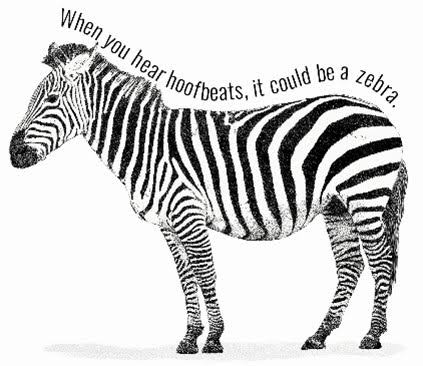
Sometimes it IS a Zebra

My heart goes out to Christina Applegate. After five years of believing she had MS, I read yesterday that she’s now been told she was misdiagnosed. But her symptoms haven’t disappeared — she’s still struggling, only now she doesn’t know why.

Twenty years ago, we were there. Watching symptoms, taking tests, going from doctor to doctor and waiting for answers. It’s like a holding pattern – waiting to land and not knowing where you are headed and what to expect.

I was thinking about her and the frustration and worry she must be feeling and then my mind went somewhere unexpected.

Could she have ALD?

Women with ALD can experience neurological symptoms that resemble MS, including symptoms she’s shared like difficulty walking, balance problems, and muscle stiffness. Some women spend years searching for answers or receive an incorrect diagnosis – MS being top of the list.

Of course, I know absolutely nothing about Christina Applegate’s medical history, and I’m certainly not suggesting that she has ALD. But I can’t help wondering whether our rare (NOT so rare) disease has been considered.

Mostly, my heart breaks for her. Imagine finally having a name for what’s happening to your body, learning to live with that diagnosis, and then having the rug pulled out from under you. The symptoms are still there, but the explanation and potential treatments are gone. If there’s one thing us ALD folks understand, it’s the exhausting journey of searching for answers.

Christina, I’m rooting for you. I hope you find the answers, support, and peace you deserve!

And maybe, just maybe, stories like yours will remind the medical community to look beyond the obvious and consider the rare — Because sometimes rare isn’t as rare as we think!

Love, Jess

Get Swabbed

Eleven years ago we were told that Jack had Adrenoleukodystropy and that the only way to stop the progression of this hideous disease was a stem cell transplant (bone marrow transplant). Anna, who was 6-years-old at the time, would have been the best option, but she was not a match. Our doctors were forced to look on the bone marrow registry for a potential donor.

Imagine being told that the only chance of saving your child’s life is if a stranger is willing to make a donation.

images-15

At the time I didn’t know much about stem cell donation. Online research did little to calm my nerves. At any given time, over 7,500 Americans are actively searching the national registry for an unrelated donor and only 2 % of our population is on the registry. And, what are the chances of finding a donor? Caucasian patients – 75%, hispanic patients 45% , asian patients – 40%, african-american patients – 25%, and multi-racial patients are faced with the worst odds. Over 3,000 people die each year because they can’t find a match.

Jack was lucky. Although there were no matches on the bone marrow registry, a stranger had donated their daughter’s cord blood (another option for a stem cell transplant) and Jack received those precious cells which stopped his disease and saved his life.

We’ve helped host many drives in the last eleven years and there have been at least three lives saved by spreading the word and helping people register. We are doing it again this weekend thanks to our friend, Elizabeth Sarkisian, and our local YMCA.

If you would like to learn more about bone marrow donation or would like to add yourself to the registry (and are between the ages of 18-55, not active military, in good general health, and over 105 pounds) please join us on Saturday 12pm-3pm at the YMCA in Maplewood.

Love, Jess

IMG_1029

Please keep in mind we are looking for people to register that are committed to donating if called. Otherwise there is false hope and wasted time for patients. Thank you!!!!!!